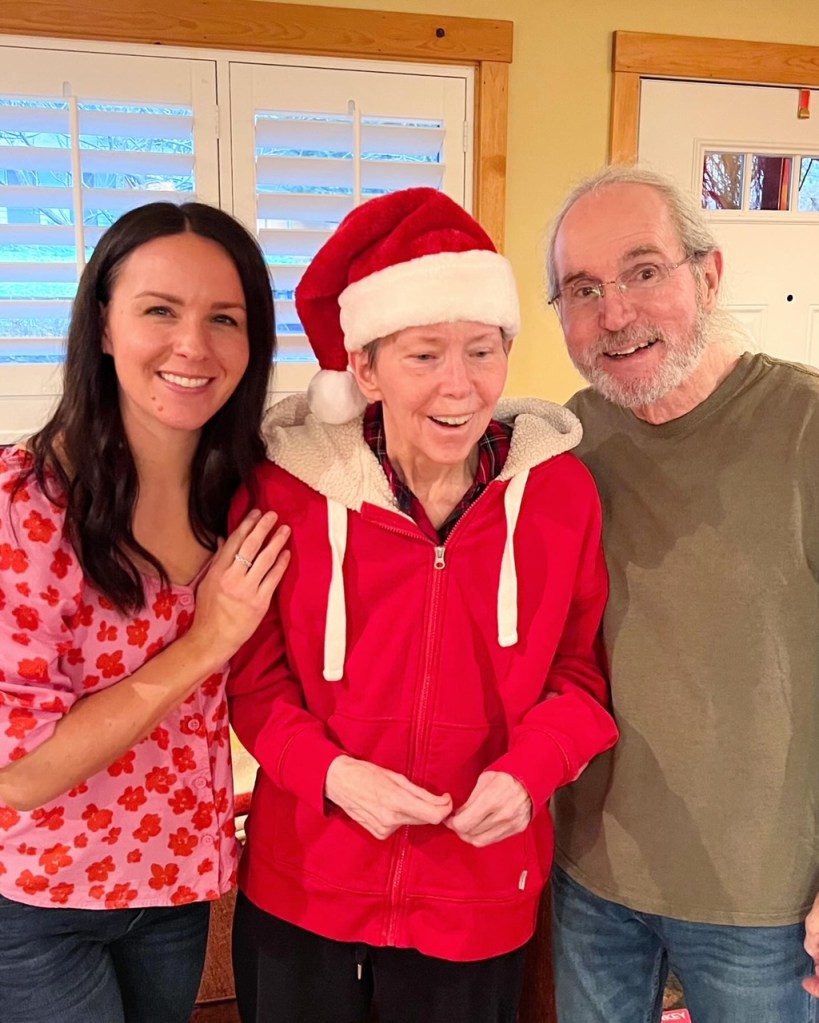
The holidays are a tricky time for many people, for so many reasons. I learned from last year’s heartbreak to go into this year’s celebrations with zero expectations. The result: a happy Christmas with my mom, who smiled all evening.
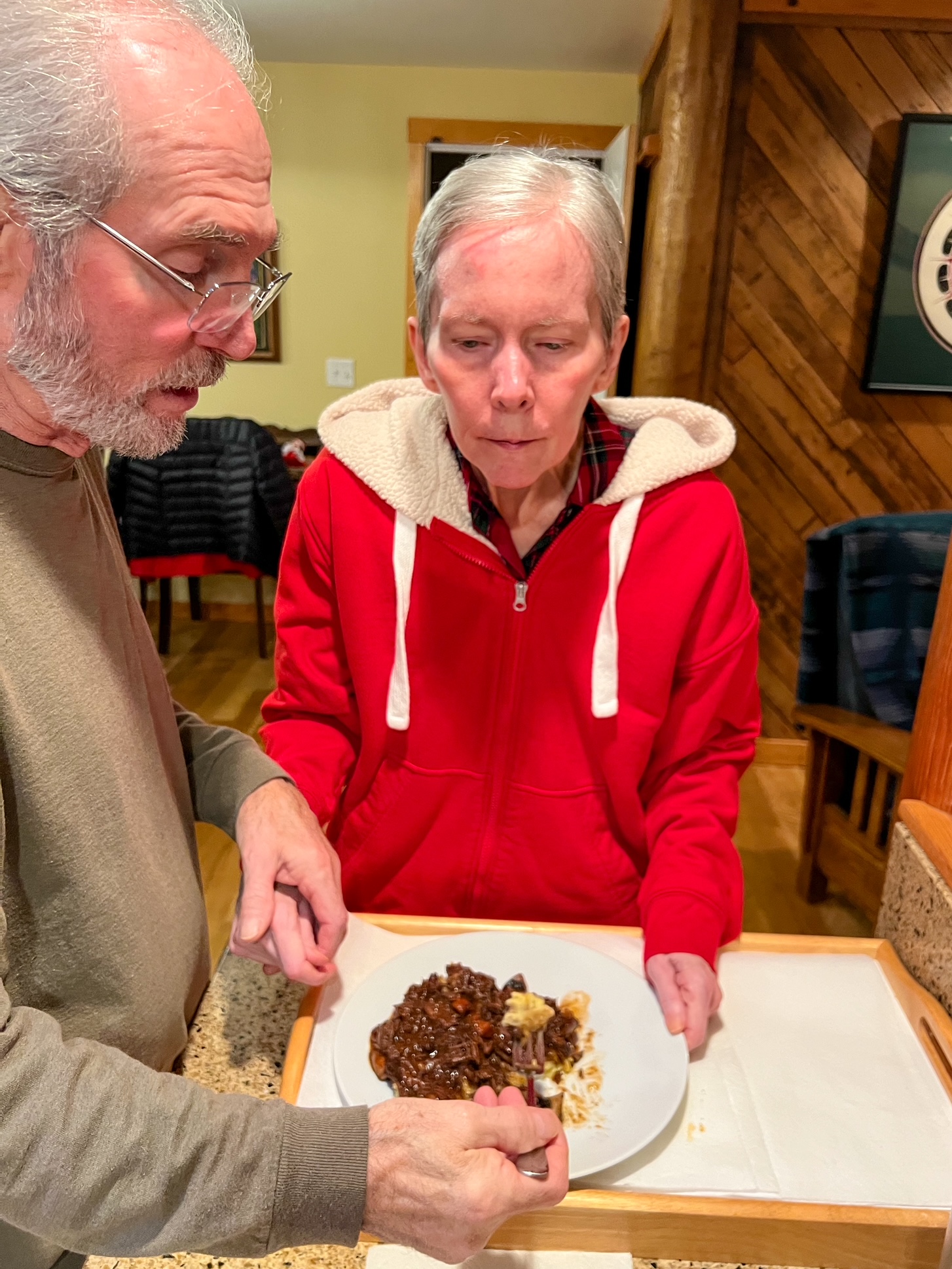
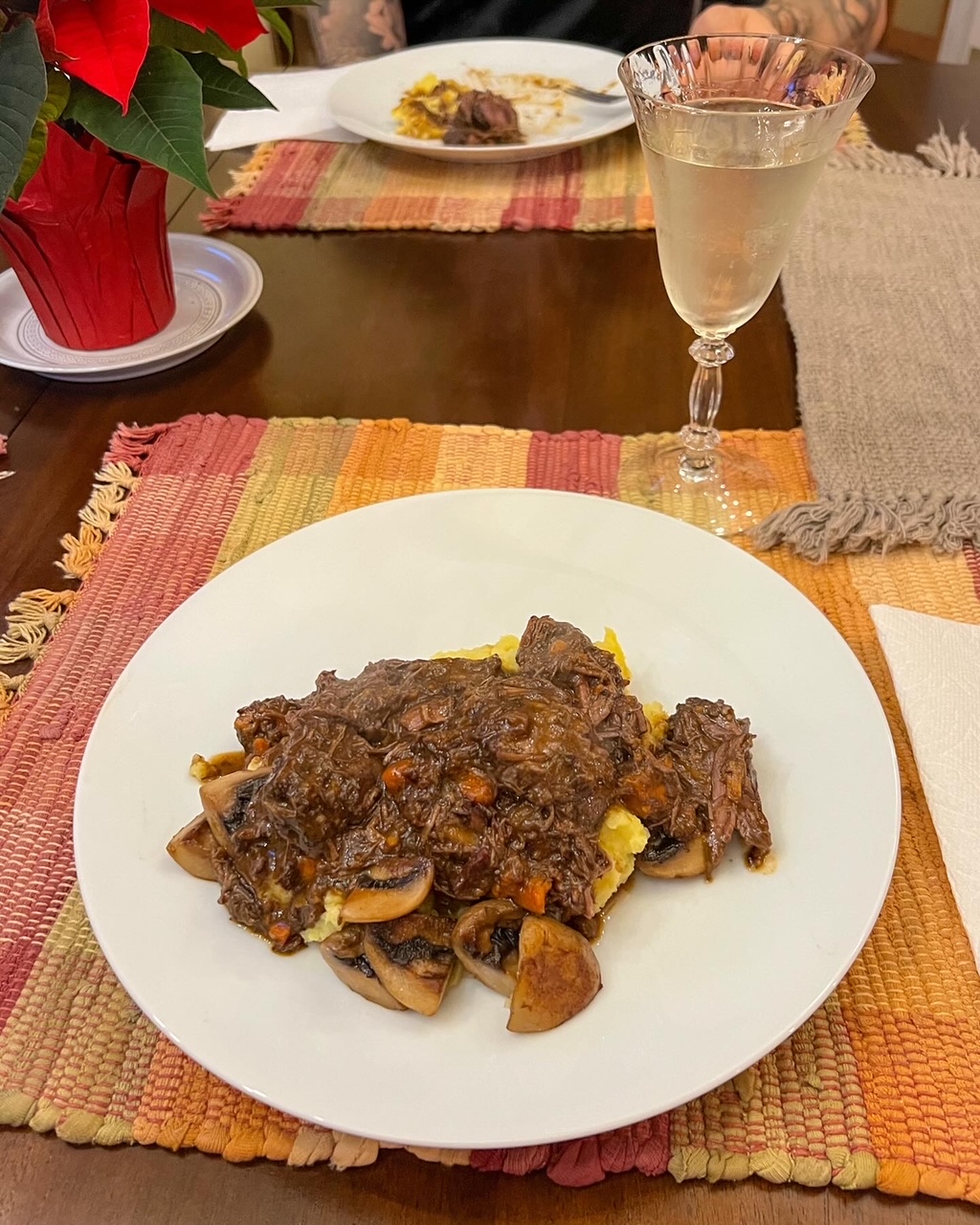
Last year, I gave her a fleece blanket printed with family photos, and she had no reaction at all when I helped her open it. This year, I put my energy into making something she could still enjoy: Julia Child’s bœuf bourguignon, a dish we made together for Christmas dinner in 2010. It’s a labor-intensive endeavor with incredible results.
At 23, I needed my mom’s guidance to make it. It felt good to work my way through the steps we once followed together and realize, at 36, I am more than capable of doing it on my own. Her gift to me then, my gift to her now: a dish filled with love and endless patience, made richer over time.
The night ended in tears all around because we knew this might have been her last Christmas. I hope it was. I would have been ashamed to say that once, but I say it with my full chest now. Nothing good awaits. I would love for my memories of her enjoying this Christmas to be the ones that endure.
I go through periods where I’m unable to read about others’ experiences with dementia because I don’t have the capacity to absorb anyone else’s pain. Other times, like now, I feel nourished by seeing my darkest feelings reflected on the page. “Dementia sucks you in with a terrible centrifugal force,” Suzanne Finnamore writes in her new book My Disappearing Mother. “It puts you in the position of wishing your own mother dead.” On top of the emotional agony of watching a parent wither away over many years, the shame around having feelings like this is unbearable. I vow to leave it behind in 2023.
I love my mom and I wish for her suffering to end. I am a good daughter and I will be relieved when she dies.
Dementia is an endurance sport, and right now feels like mile 20 of a marathon. The toughest bits stretch far ahead; the finish line keeps moving, and a different pain awaits there. I will do whatever it takes to continue on, side by side with my mom.
At 23, I needed her guidance. At 36, I am more than capable. My gift to her now: a journey filled with love and endless patience.
Four years of grieving what was and accepting what is.
When I’m with Janet, I wonder where my mom is. She might wonder the same about her daughter.
When I dropped her off on Saturday after a visit at her former home, I hugged her and told her I loved her. She politely replied, “Thank you for having me over today,” like she would to a neighbor she doesn’t know very well who randomly invited her in for tea.
I hope her daughter still exists in her mind as someone younger and more carefree, with fewer grey hairs and fewer hurts. I wish I still existed that way, too, but I accept what is.
If she doesn’t recognize me as her daughter and I don’t recognize her as my mom, we are virtually strangers. We are linked through blood and birth, but as if in a past life.
Aaron and I watched the film Past Lives on Saturday night (potential spoilers ahead). In it, Korean childhood sweethearts Nora and Hae Sung are separated by a move and reconnect intermittently throughout their lives. They know each other so well from their younger years, yet are strangers as adults. They seem destined to be together, but as they grew up, their paths diverged in such a way that makes it nearly impossible.
The concept of in-yun is woven throughout the film. Nora explains: “It’s an in-yun if two strangers even walk past each other in the street and their clothes accidentally brush, because it means there must have been something between them in their past lives. If two people get married, they say it’s because there have been 8,000 layers of in-yun over 8,000 lifetimes.”
At one point, Hae Sung wonders if they are currently experiencing a past life, and what will their relationship be in the next?
The film is gorgeous and heartbreaking; the perfect example of holding many opposing truths at once, and of grieving what was and accepting what is.
I don’t know if in-yun applies to mothers and daughters, but I do know my mom and I have left our marks on each other. I hope it’s enough.
It comforts me to think that, while her body remains here on Earth, my mom’s spirit—the very essence of her that I’ve watched gradually fade away over the past four years—may already be somewhere between this life and the next, waiting to know me again.
With Alzheimer’s, there is nothing to fight. There is only a fatal truth you might at first deny and wish away, then curse and mourn, then ultimately surrender to. Trying to hold on to your loved one—as they were before or as they are now, whatever that may be today—is like holding a handful of sand. You can clench your fist tightly for as long as possible, but every last grain will inevitably slip through your fingers. At some point you realize it’s a mercy, for yourself and for them, to let go.
Perhaps that’s why I felt a wave of peace last week after we enrolled my mom in hospice care. Our Sisyphean task had ended; it was time to surrender. It felt like a seismic shift to go from doing everything we could to improve and prolong her life, to simply clearing the path and steeling ourselves to accompany her on this final leg of her journey. The only goal now is to ensure her a peaceful and painless death. It’s a hard thing, but it’s the right thing.
The worst part is that we will lose her twice. We lost her once, in mind, years ago; we’ll lose her in body next. As upsetting as it is to see her in her current state, at least I can still hug her. At least she still responds in kind when I tell her I love her. Soon, even those last few bits of my mom will be gone forever.
But there is comfort in knowing I will find her again after her death. In her magnificent book The Last Ocean, Nicci Gerrard writes:
“Death is never a slight thing, however peaceful a passing is, however minute the distance crossed. Just a breath away, then like a feather being blown with a single puff and a whole world has disappeared.
“And yet death can also restore a person, especially when that person had been un-made by dementia. Once they die, they are no longer only old and frail and ill, they are no longer only confused and forgetful, no longer a wrecked body and a failing mind, no longer not themselves. Because they have gone from us, they can come back to us and be all the selves they have ever been. Young, old, everything in between. Robust, vulnerable, everything in between. And often we fall head over heels in love with all these selves and we understand how they contained multitudes.”
I shelved the practice of missing my Real Mom long ago. It felt like a betrayal to who she is now to long for a previous version of her. Why push aside the person in front of me in a favor of memories of someone who no longer exists in this world? She is still my mom, after all. Not in the way she once was, but through no fault of her own. I know my Real Mom wanted desperately to stay with us. The least I can do is stay with her, holding her hand through every heartbreaking devolution.
I know I’ll eventually miss even the hardest days with her. But I also look forward to reclaiming my Real Mom. I hope to shuffle these most recent years to the back of my mind and make space for the warm glow of happy memories to come flooding back. I’d like to trade the awkward, one-sided conversations for our long discussions over fish tacos at the mall. Can I archive the many times I wiped her nose and changed her briefs and hear her laugh again instead?
All of it will always exist, but I hope my first thoughts of my mom each day will not be of this painful ending, but of the very best of her. I suppose it’s on me to choose to play the highlight reel. That’s the gift in this tragedy: Because they have gone from us, they can come back to us.
She has already popped up a few times. When we received the hospice referral from her doctor, I lay awake that night with this image from her 2015 wedding day in my mind. She was smiling, in love, happy and hopeful for the future.
I cried to this version of my mom: “I’m so, so sorry I couldn’t save you.” My heart broke for her, knowing now what was ahead. I felt ill, like I wanted to peel off my skin, as if sacrificing myself would make any difference. I wanted to go back to that day and somehow change it all for her.
The sick thing—the thing that makes me grateful for biweekly therapy sessions over the past two-and-a-half years and counting—is that I’m not sorry for my current mom. Rather, I’m relieved there is an end in sight to her suffering. Different feelings for different moms. My therapist earns her paycheck a thousand times over for helping me sort through everything.
The other time my mom popped up was when I drove her back to memory care after a recent weekend visit at her old home. She was sitting shotgun next to me, silent, staring out the windshield with her mouth gently hanging open as if she didn’t have the energy or muscle memory to close it. In a flash, I saw my Real Mom sitting there instead. Her gaunt cheeks were plump again, her hair was styled, her clothes were carefully chosen and free from the stains of spilled food or worse. We were heading to lunch, or to her favorite Eddie Bauer Outlet, or to try on wedding dresses for the millionth time. She was there. And she still is, somewhere.
I’m not sure how to navigate this hospice period. (I bet the simple and correct answer is: one day at a time.) There is inevitability and uncertainty. How long? I hope not too long, for her sake—but also not too short. I need time to say all the things, to let her know she was the best mom and grandma, to assure her that we’ll all be okay and that she shouldn’t be scared to leave whenever she needs to. But I also don’t want to freak her out; she doesn’t know she’s dying. That’s a blessing, and also terribly sad.
My mission is to make her feel loved, like it’s her birthday or Mother’s Day every day. She has lost her appetite and taste for most food, but she’ll still make short work of a brownie or ice cream bar with her tiny bites. And while she is nonreactive to many stimuli, the right music still gets her smiling and dancing with her hands.
Let’s make this thing a party. Let’s indulge in chocolate and dancing and joy until the very end. Let’s give this life a beautiful send-off, for what is it if not to be savored with the people we love?
“We still need things from our parents—some understanding, some piece of love, whatever it is. There never comes a time when you … don’t sort of hope, even in their decline, that they can still be there for you.”
This is a story about getting drunk in a hot tub, but it’s not quite as exciting as the circumstances imply. For that, please proceed directly to a very different corner of the internet.
It was a Thursday, two days before my thirty-fifth birthday. I had a shitty workday and, by quitting time, needed to soak in our hot tub with a big glass of sparkling rosé in hand.
We hung out in there for a while as a family, and I had such a lovely buzz going that I fetched another glass and returned to the hot tub as Aaron and Evie got out. I sipped and scrolled on my phone as both forms of bubbles melted away my tension. I must have exhausted the content on my social media feeds because I ultimately found myself in my voicemail archive, staring at dozens of entries indicating messages from my mom.
Since her early onset Alzheimer’s diagnosis in 2019, my mom has slowly slipped away. It happened so gradually that every time I visited, her general reticence and increasingly jumbled words seemed normal. But I remembered, staring at those voicemails, that she was once upbeat and articulate. She once knew how to call me, and did so often to confirm plans, thank us for coming by the house, or check on us during inclement weather. And she always called on May 21 to sing happy birthday to me.
Two habits that drive Aaron crazy—my tendency to keep my phone on silent and never answer calls, and my total disinterest in deleting anything—proved valuable in that moment. My voicemail archive held pieces of mom I thought were lost forever.
I began listening to her messages and transported back in time. It was 2018, and my mom was wondering what time we were meeting at the mall for our Mother’s Day shopping trip. It was 2019, and she needed to know my Social Security number to update her beneficiary information for a new insurance plan. It was 2020, and had I heard about this virus going around?
I closed my eyes and listened to the mom I used to know, the mom who no longer existed—at least in any way she could communicate to me. I let my now intense buzz convince me that I had just missed those calls, that she was still the same. I could call her back right now and say, yes, I will stop by the store on my way over and pick up a bag of ice; no, don’t worry about paying me back.
And then I listened to the birthday messages. She and my stepdad sang an exaggerated version of happy birthday, with my mom replacing “dear Devon” with “dear sweet Devie Doodle Bug.”
It was then I started crying, realizing I’d never get a birthday phone call or voicemail from her again.
This is a small loss in the grand scheme of everything Alzheimer’s has stolen from us. But that evening—thanks in part to potent rosé—it unleashed a tsunami of grief.
In an effort to Be Okay and enjoy my life, I rarely tap into that deepest level of hurt. I’ll shed a few tears every now and then, particularly during therapy, but mostly I keep things tight. With my defenses down, I gasped for air as sobs overtook me.
I found myself wrapped in a towel, crumpled on my bedroom floor, raging over the phone to my stepdad about how fucked up this whole situation is. Why her? Why us? He understood and talked me down from the height of my hysteria.
Eventually I pulled myself together enough to get dressed and take Wally for his nightly walk. As we set out around the neighborhood, I called my mom on the off-chance she’d answer the phone. I just wanted to hear her voice. I just wanted to know she was still here.
She didn’t answer my call. Normally I would leave it at that, but something compelled me to try again.
“Hi, Mom?” I said, my voice cracking. “How are you?”
“What’s wrong?” she asked, concerned. I couldn’t believe she’d recognized the heartbreak in my voice.
“I just miss you,” I replied. “You… live so far away.” Our physical distance wasn’t the problem, but I didn’t want to mention the real issue.
“I know,” she said. “I miss you, too.”
I started crying again, struck by her clarity. It was 8:30pm and she was probably exhausted, yet she was able to express herself in a way I hadn’t witnessed in a long time.
Our phone conversations—on the rare occasions she answers—typically last about five minutes. I tell her everything that’s happened in the few days since I saw her last, then run out of things to say. She doesn’t contribute much, and there’s only so much silence I can bear to let hang between us.
On this night, we talked—like, a real back-and-forth conversation that mostly made sense—for 19 minutes.
We talked about my birthday coming up in a few days, and she asked how old I was turning. “Thirty-five,” I said, and she laughed: “How can that be? I still feel about forty!”
We talked about memories from when she really was forty and I was eleven, which were much more vivid for her than anything that happened in the past week. We talked about how she was worried that she hadn’t heard from Don lately, even though I know he calls her multiple times a day, every day. And we talked about how we missed each other, and how she was sad to hear me sounding sad. We said we loved each other, and that we’d talk again soon.
After we hung up, I took huge, deep breaths and tried to memorize everything about what had just happened. I had taken a photo of a stunning sunset during our chat. I took a screenshot of the call log. I wanted tangible evidence that I had gotten my mom back, if only for 19 minutes.
It struck me that I hadn’t been mothered in a long time. It’s not something I really appreciated when I did experience it, and it’s not something I realized I’d missed until that moment. My mom and I always had a good relationship—except for a few teenage years, when my hormones may as well have been napalm—but it’s not like I constantly turned to her with my boy troubles or friend drama. I didn’t seek from her the words of parental wisdom you hear at the end of every Full House episode.
But she was always there for me for the big things, like when my BAC was higher than my GPA the first quarter of college and I was hospitalized with pneumonia from wearing only skimpy going-out tops to freezing frat parties. Or when I wanted to go on the pill and asked her to take me to the doctor since I was still on her health insurance, and she did so without judgment. Or when I revealed I was thousands of dollars in credit-card debt after graduation, and she helped me make a plan to pay it all off instead of admonishing me for my stupidity. (She was relieved since she thought my big secret was that I was pregnant—which I never was, thanks to the pill.)
I still try to rely mostly on myself (and my therapist) to manage life’s everyday struggles. I like to keep my sadness contained, not wanting to infect others. Keep things tight, right? But it turns out I do still need my mom.
…
I went on to have a lovely birthday weekend, celebrating in person with friends and all different parts of my family, including my mom. I didn’t get a happy-birthday voicemail, but I did get an in-person rendition, which is definitely better. Someday that will be gone, too.
As a mother, I now understand my birthday means even more to my mom than it does to me. It’s my birthday, but it’s her Birth Day. I think about how April 29, 2016, is the most special day of my life, and figure May 21, 1987, must be right up there for my mom. I’m her second kid, but she made it no secret she wanted a girl and would keep trying until she got one. I may have come bursting out before she could get a desperately wanted epidural, but I think I made up for it with the fact that she’d never have to go through that again.
…
I try to be grateful for what I have left of my mom and not focus on what we’ll lose next, or guess at when she’ll leave us for good. I’m conflicted between wanting to keep her earthside forever and wanting her to be released from her pain.
She endured my excruciating arrival; I’ll endure her excruciating departure. Love is at the center of it all.
I don’t know what happens to us after we die. I’m humbled enough by the magnitude and mysteries of the universe to admit that. I respect anyone who possesses the faith to be certain that heaven or hell or some other manner of afterlife awaits us. There is safety in certainty. I prefer to marvel at all the possibilities.
My mom has always said, half jokingly, that she’ll haunt me when she’s gone. If she has any choice in the matter, I’m sure she will. But if there is some grand plan for our existence, I don’t believe hanging around my house and flickering the lights is her destiny. I like to think she’ll move on to something better.
I hope her energy, unleashed from the plaques and tangles that choked it in this lifetime, finds freedom as something wonderful in the next. Maybe she’ll be a bird or a butterfly. Maybe the universe has a sense of humor and she’ll be an elephant. Or maybe her energy will disperse, becoming one with the elements. Maybe it will coalesce, on occasion, when it feels some force pulling it back together and toward something it once knew.
When my mom is gone, on my birthday, I’ll listen for her. Maybe I’ll let my skin go wrinkly in the hot tub and remember that night it was a time machine. Maybe a spring breeze will tickle my neighbor’s wind chime. Maybe I’ll close my eyes and believe it’s my mom calling to sing to me.
“Pa threw mattresses into the wagon. Ma carefully spread their patchwork quilts over them. ‘We can’t leave these behind,’ she said. ‘All our joys and sorrows are sewn up into the patches.'”
Eleanor Coerr // The Josefina Story Quilt
The quilt my mother made for my daughter tells a story she didn’t intend.
The front, meticulously pieced together in 2015 when she found out I was pregnant with a girl, features strips of brightly colored fabric cut on the bias, perfectly straight, edges crisp—the work of a lifelong quilter.
The colors were chosen with intention: pink, of course, but well balanced with sunny yellow, sprightly green and a rich purplish-blue. You’d find these colors just before dawn on a spring morning, when the dusky sky gives way to the sun’s rays spilling onto new shoots of grass.
Evie was born on such a morning in late April 2016, just before dawn. By the time the light and those colors crept in through our window, we barely noticed; she had already illuminated everything.
The back of the quilt bears Evie’s full name, birth date and statistics, machine-embroidered by another woman onto a patch that my mom then sewed on by hand. The stitches are clumsy, like the ones I made when my mom taught me how to make my own little quilts when I was eight years old. I can’t remember exactly when she sewed this patch—2018, 2019 maybe—but I remember it took a long time for her to do it and to return the quilt to me.
Somewhere in those years, between the front and the back, when I was busy feeding, wiping, shushing, bouncing, not sleeping and falling deeply in love—learning to be a mom—my own mom began to slip away.
…
There’s a feeling that accompanies the deepest hurts, in the very back of the throat: an involuntary clenching that can’t be relieved by methodic breathing or swallowing hard. When I get that feeling, I know the best course is to surrender to the tears, let myself make the ugly, contorted faces, scream if I need to.
That feeling means something different to everyone. For me, it’s the feeling of missing my mom. Not the one who’s here now, but the one who was lost between the front and the back. The one whose wry observations and easy laughter grew quieter until they disappeared. The one who danced around the room when she found out she was going to be a grandma, then hesitated to play with her granddaughter for fear she would do or say the wrong thing. The one who booked flights and ordered catering for years as an executive assistant, then struggled to make sense of a digital clock.
Sixty-one is not an age at which one should be diagnosed with Alzheimer’s disease, yet there she was. Sixty-two is not an age at which one should be moved into memory care, yet there she is.
There are so many losses to grieve. And the trouble is the losses continue to mount as my mom’s cognition declines. There are days I wonder if things will be better when she’s further along and not so acutely aware of what’s happening to her. I almost want for her to slip into some blissfully ignorant state, like floating on her back in calm, cool water on a stiflingly hot day. Then I panic that she’ll disappear beneath the surface for good, and I hold onto her tighter.
She recently said to me, “I’m afraid one day I won’t know who you are.” I’m afraid of that, too. I took a deep breath and said, “I know. That might happen. But that’s OK. I won’t hold it against you.” Another deep breath. “I think even if your mind doesn’t recognize me, your heart will still know who I am.”
I think of the hundreds of hours I’ve spent with my daughter pressed to my chest, my skin alive with the warmth and sweetness of hers. I think of the searching eyes that have stared into mine since the very first time they opened. Could I ever be in a room with her and not feel, somewhere in my bones, the pull of those invisible threads that bind us?
The mind may fail, but the heart still knows.
I will meet you wherever you are today, and tomorrow I’ll meet you there, too.
I will walk with you to the very end, holding your hand, holding nothing against you.
And when I have to let you go, I’ll gather the quilts your hands made, sewn up with all your joys and sorrows, and crawl beneath them, awash in the warmth of your love.
…was my momma! I spent today at her house, helping her out with stuff as she recovers from her surgery, and also working remotely from my work laptop.
She’s doing well, much better than I expected at this point, and we’re just really relieved this first step of treatment is over with.
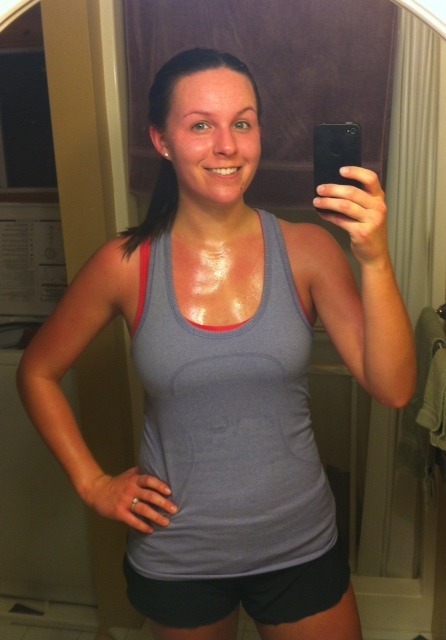
My secondary Valentine’s Day date was the treadmill! I miiiiight have eaten an entire (small) box of chocolates over the course of the day, so I really needed to get a run in. My mom has a treadmill, so I didn’t have to run outside, but it also made me ridiculously sweaty.
6.2 miles, 58:52, 9:30 pace. I did four half-mile speed intervals somewhere in there, so we’ll call this a speed workout, even though it wound up being on the slower side overall.
The last time I was on a treadmill before tonight was at physical therapy in June, I think. I do not miss it one bit. Give me pavement or give me death!
Since I didn’t see Aaron today, I mischievously conspired with his friend/co-worker Holly to have an embarrassingly large Valentine’s Day balloon and oversized card delivered to him in a loud, over-the-top way in front of everyone at work.
There’s no place for subtlety on Valentine’s Day. Go big or go home.
Our real celebration is tomorrow evening at a fancy restaurant. I shall fast tomorrow afternoon in preparation for our feast. There’s no place for dainty eating on, err, the day after Valentine’s Day… or something.
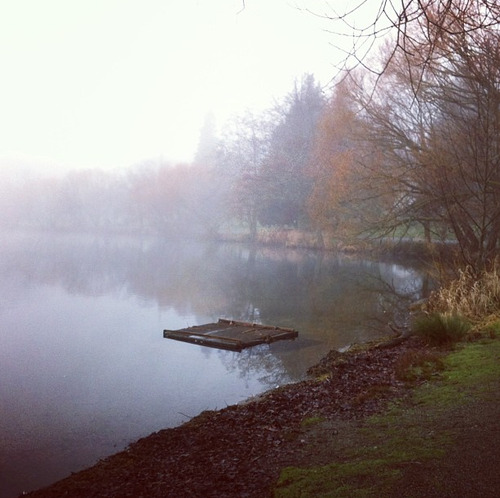
This morning I got out early for my easy three-mile recovery run:
This run was all foggy-like. I loved it. The air smelled super-fresh and I felt like I was in a dream. The fog condensed in sweet little droplets on my eyelashes.
Today Aaron and I spent lots of time with both sides of his family. We got to celebrate the birthday of the oldest member of his family (Grandpa O, age 87) and receive a finger painting from the youngest (Ben, age 1).
From 1 to 87 and everywhere in between, I couldn’t ask for better people to add to the illustrious list of those whom I call family. I am a lucky gal.
On this Sunday night, when I would normally steel myself for a week of dedicated training, I instead take a deep breath and prepare for what will undoubtedly be a tough week.
My mom will have surgery on Tuesday in the first big step of her treatment. I’ll be hanging out with her at her house on Thursday and Friday as she recovers, which means I won’t see Aaron on Valentine’s Day. Some things are just so much more important than a date on a calendar.
There is love in the form of red roses and cellophane-wrapped boxes of chocolates, and then there is L.O.V.E. — that all-consuming, heart-bursting feeling you have when you’d give anything to make sure that another person is happy and healthy and safe.
I think my mom felt that for me many months before I was born, and I’ll feel that for her up until, and through, my last breath.
I hope y’all feel a little bit of that this Valentine’s Day.







 Dev on Running