“Not a day goes by that I don’t miss my mother.”
This comes from a core memory I have of my mom and I lying in bed sometime during my elementary school years, chatting before she tucked me in for the night. I don’t remember the context of the conversation that came before or after, but I clearly recall the quiver in her voice, the heartbreak behind each word as she said it. It was perhaps the first time I realized my mom wasn’t invincible.
My mom’s mother, Mary Behrens, had diabetes and died from a stroke in 1992 at age 69, when my mom was 33 and I was 4. I have no memories of her or of my paternal grandmother, a lifelong smoker who died of lung cancer in 1991, also at 69.
Even if my grandmothers had lived long and healthy lives, I wouldn’t have grown up knowing them well. My parents moved us away from our extended family in Southern California to the Pacific Northwest in 1989. The story goes that they fell in love with Seattle’s gorgeous greenery, temperate climate, and more affordable real estate on a summer road trip to the 1986 World’s Fair in Vancouver, British Columbia. They even walked through a few open houses on Capitol Hill. Since I was born the following spring, I have strong reason to believe I was conceived on that trip, perhaps in the camper they borrowed from my mom’s father. Romance!
I’m grateful my parents moved us to Washington. I loved growing up here, with our mountains and lakes and distinct seasons. The sound of rain instantly makes me feel at home. But I’m sad I never knew my grandmothers and only saw my grandfathers, uncles, aunts, and cousins every few years. I have stacks of letters from my grandfathers and knew them well enough from our visits, but we never had the kind of relationship that can only be cultivated by living in close proximity.
It must have been difficult for my parents to leave their families in California to raise their own a thousand miles away. It must have been even more difficult when both their mothers fell ill and died just a few years after we left. Suddenly, the distance between them could no longer be bridged by a phone call or flight; the missing could not be alleviated.
I was thrilled for Evie to be able to grow up with all her grandparents nearby. My mom especially couldn’t wait to be “Nana.” She talked about putting a crib in her sewing room so she could babysit all the time, but that never happened due to her decline from early onset Alzheimer’s. She and Don only ever watched baby Evie once for a few hours while we attended a friend’s wedding in my hometown.
I now sit on the floor of that room from time to time, slowly sorting through my mom’s belongings and packing up boxes to take to Goodwill. Sometimes I think about the different memories that could have been made there, and that’s what makes me saddest about all this: mourning the relationship Evie is missing out on with her nana. Nana is still here, but not in the way my mom and I had both hoped.
They do spend time together, and my mom always has a smile on her face when Evie is around. Evie has learned a great deal about patience and compassion, as she’s played the role of assistant caregiver and even comforter to me at times. She’s had to grow up a lot faster than many kids in that regard, and learned much earlier than I did that her mom isn’t invincible.
Evie is incredibly close with Aaron’s mom, Greta, who goes above and beyond to nurture their special relationship. “GG” takes Evie on adventures to Skagit Valley to see the tulips and Bainbridge Island to hunt for beach treasures, plus invites her to sleep over on weekends in her own room outfitted with cute bedsheets and plenty of stuffies.
I’m eternally grateful for Greta. She is the grandma I wish I could have had. She is the mother-in-law I’m so lucky to have. Thanks to her, I don’t think Evie feels like she’s missing out. Only I feel a hole in my heart for what might have been.
One summer Saturday, I arrive at Don’s house for a visit and ask how my mom has been that day.
“When I picked her up, she was crying about her mom,” he tells me. I haven’t seen her cry since we adjusted her meds, so this really strikes me. Considering all the things my mom has lost—memories, motor skills—it feels particularly cruel it’s the feeling of missing that remains. It has endured for half her life: 33 years with her mom, 33 years without. But perhaps this is proof love lives outside the brain.
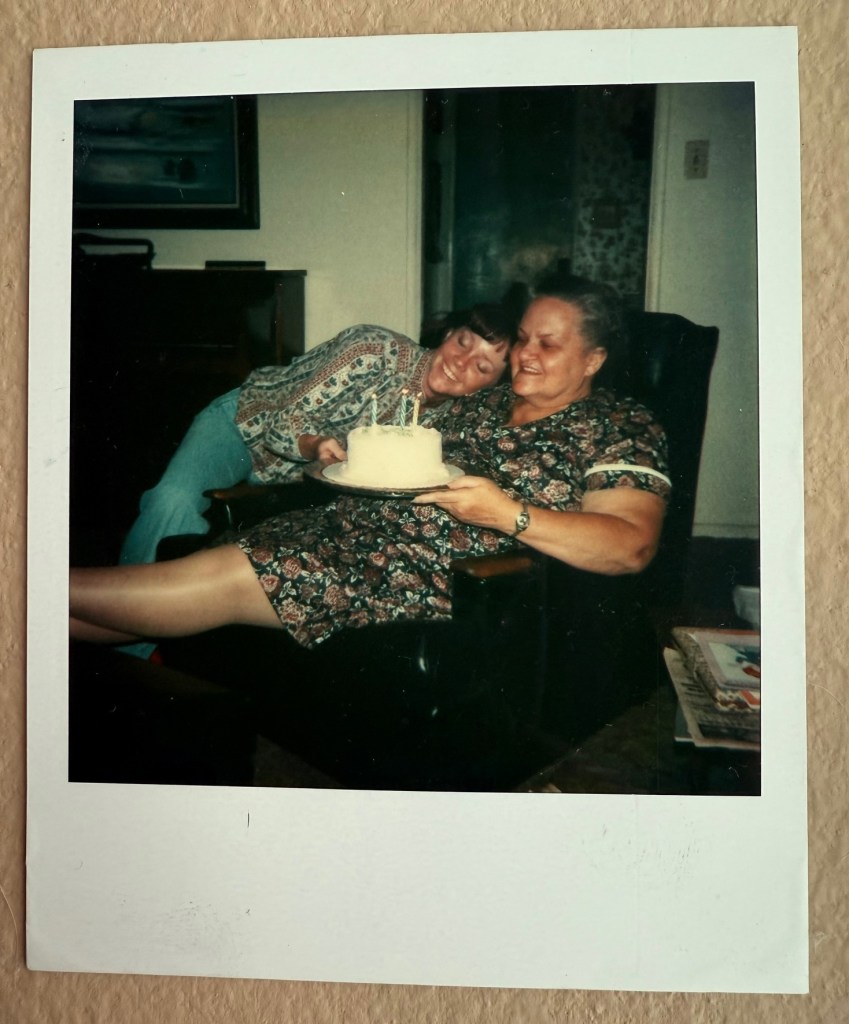
Much earlier in my mom’s illness, I looked through her will and found it was nearly complete, save for a blank worksheet meant to detail what she wanted done with her remains. I was nervous to upset her, but needed to ask before she could no longer understand or respond to the questions: What kind of funeral do you want? Where should we put your ashes?
Her answers are scrawled in the Notes app on my phone: “Mass at Saint Teresa of Calcutta Catholic Church. Ashes in cemetery with her parents.”
At the time, I was sad to learn she wanted her ashes laid to rest in California. I wished she wanted at least some of them closer to home so I could visit more often and feel her around me. But upon further thought, I realized home is somewhere else for her, and I don’t believe one’s earthly form means much at all once the spirit departs. If reuniting my mom’s remains with those of her parents helps at all to cure her missing, I’m happy to do it.
Another Saturday in July, it’s too warm to take our usual midday trip to Cottage Lake Park so my mom can visit the ducks and watch kids play on the playground. I tell Don I’ll take her for a little spin around the block once we arrive back at the memory care facility instead.
It’s late afternoon then and the sun is filtering gently through the trees, a cool breeze tempering the day’s brutal heat. On a whim, I push my mom’s wheelchair over to a little garden next to the parking lot and sit beside her on a bench. Now feels like as good a time as any to say the things I’ve been meaning to say to her while she can still potentially understand them.
I take her hand and tell her she’s been such a good mom and taught me so much about how to be a strong woman.
She continues staring into the distance.
I tell her I hate what’s happening to her and wish so badly I could change it all.
She remains stone-faced.
I tell her we’re all going to be okay—Don, Brandon, Evie, Aaron, and me—but we’ll always miss her so much. Just like how she misses her mother, I add.
At this, she stirs and reacts for the first time. “I think she might be gone,” she says.
I don’t want to upset my mom, but I feel too cracked open to lie to her. Instead, I squeeze her hand in what I hope is a comforting gesture.
“Yeah,” I say quietly. “I think she might be gone. But I’m here with you.”
She does not respond. We sit in silence for a few minutes, still holding hands, me trying and failing to hold back tears. Then I wheel her into the building for dinner.
It’s hard to explain the chasm that exists between us even when—especially when—I’m with my mom. We are on different planes of time and space. I may not even exist in her current reality, whereas I could not exist without her in mine.
But we have some things in common now. We both feel a little lost and scared. We both have the primal urge to go to our mothers for comfort. And both of them are inaccessible to us, just out of reach on the next plane.
I can always go to the well of love she so generously filled up for me. Still, not a day goes by that I don’t miss my mother.
 Dev on Running
Weeping at work. All my love, Devon. Thank you, as always, for sharing your beautiful thoughts and perfect words.
LikeLike
DevonThis is so beautiful and YES I see God using your amazing gift as a writer to walk along side of many others as they also live the realities of this hard journey. Please remember you have an Aunt and cousins th
LikeLike
I saw you posted, and saved it for a quiet moment where I could properly focus and read. This was one of the most beautiful tributes I’ve read showing how special and deep a mother/daughter relationship can be. I am so sorry you’re going through this. I think about you and your family often, and am sending you so much love from the east coast. Thank you for sharing these words with us, and the reality of how challenging this disease is on everyone it touches 🩷
LikeLike